

TABLE OF CONTENTS
INTRODUCTION
THE MONEY REVOLUTION
The Problem That Started It All
Decentralization and Its Revolutionary Impact
Beyond Money: Industries Transformed
Real-World Implementation Success Stories
HOW BLOCKCHAIN REALLY WORKS
The Three Pillars of Blockchain Technology
From Click to Confirmation
Smart Contracts and Blockchain Applications
Understanding Blockchain’s True Potential
YOUR FIRST STEPS INTO CRYPTO OWNERSHIP
Understanding the Cryptocurrency Terrain
Wallets Demystified: Your Digital Fort Knox
Making Your First Purchase
Sending and Receiving Like a Pro
FORTIFY YOUR DIGITAL WEALTH
The Cybersecurity Challenge
Building Your Personal Security Fortress
Choosing Platforms and Managing Risks
Regulatory Reality: Taxes and Compliance
YOUR CONFIDENT FUTURE IN THE BLOCKCHAIN ERA
From Confusion to Confidence
Blockchain’s Expanding Horizons Beyond Digital Currency
Your Path Forward in the Blockchain Era
Embracing Your Role in the Digital Transformation
DISCLAIMER
The information provided is intended solely for educational and informational purposes. I do not take any responsibility for the outcomes that may arise from the application of the material within. While I tried to ensure the accuracy and relevance of the content, I cannot be held accountable for any errors or omissions, or for any consequences resulting from the use or misuse of the information provided. The responsibility for any actions taken based on the information lies solely with you the reader.

INTRODUCTION
“You’re about to get rich.” That’s what every cryptocurrency ad promised you in 2021.
Then came the crashes, the scandals, and the headlines about people losing their life savings. Now you’re wondering if blockchain and cryptocurrency are just elaborate scams designed to separate you from your money.
The truth is that blockchain technology is revolutionizing how we handle money, contracts, and digital ownership. But most people still don’t understand how it actually works. They buy into hype instead of knowledge. They follow trends instead of fundamentals. And they lose money because they never learned the basics.
This blog changes that.
Forget the technical jargon and complex explanations that make your head spin. Forget the get-rich-quick schemes and the fear-mongering headlines. This guide strips away the confusion and shows you exactly how blockchain technology functions, why it matters, and how you can use it safely and profitably.
This guide serves different readers. Entrepreneurs will find new business opportunities. Investors will understand this asset class. Anyone feeling left behind by technology will find practical answers here.
You’ll learn why major corporations like Microsoft, Walmart, and JPMorgan Chase are betting billions on blockchain technology. You’ll discover how to evaluate cryptocurrency projects without falling for marketing tricks. Most importantly, you’ll gain the confidence to make informed decisions about your financial future.
By the time you finish reading, you’ll understand the difference between speculation and investment. You’ll know how to spot scams from legitimate opportunities. You’ll have the tools to participate safely in the blockchain economy. You won’t risk more than you can afford to lose.
The money revolution is happening whether you participate or not. This post ensures you’re prepared for what comes next.
Part One
THE MONEY REVOLUTION
Ten years from now, explaining how money used to work through banks will sound outdated. It will be like describing how we used to rent movies from Blockbuster.
The way we think about money, send it, and store it is changing faster than most people realize. Just like those who understood the internet early had big advantages, those who understand this money revolution today will be ready for tomorrow’s opportunities.
The Problem That Started It All
For hundreds of years, we trusted banks to handle our money. We had no choice. If you wanted to send money to someone far away, you needed a bank. If you wanted to keep your money safe, you used a bank. Banks became the middlemen for almost every money transaction in the world.
But this system had serious problems. Banks could freeze your account. They charged high fees for sending money across borders, could make mistakes, or even fail completely. During the 2008 US financial crisis, many banks nearly collapsed, causing people to lose their homes, savings, and trust in these institutions.
The crisis showed everyone that having all our money controlled by a small number of big banks was risky. When these banks made bad decisions, regular people paid the price. This created a perfect moment for someone to imagine a different way.
In 2009, a mysterious person named Satoshi Nakamoto had an idea. What if we could send money directly to each other without needing banks at all? What if we could create a system where no single organization controlled everyone’s money? This idea became Bitcoin, the first cryptocurrency.
The journey from that first idea to today’s blockchain revolution happened faster than anyone expected. In 2009, Bitcoin launched quietly to a world where most people had never heard of it. The few who did thought it was just a computer experiment that would never work in the real world.
By 2017, everything changed as cryptocurrency became front-page news. People who had bought Bitcoin years earlier became millionaires, and suddenly everyone wanted to learn about digital money. That year alone, 902 new cryptocurrencies were launched, as cited in an article from the New York State Society of CPAs. The total value of all cryptocurrencies grew from almost nothing to hundreds of billions of dollars.
Then in 2021, something even bigger happened. Large companies and institutions started buying cryptocurrency. Tesla bought Bitcoin for their company treasury. Major banks began offering cryptocurrency services to their clients. This wasn’t just individual investors anymore. The biggest financial institutions in the world were taking digital money seriously.
Quote from Satoshi Nakamoto’s original Bitcoin whitepaper: “A purely peer-to-peer version of electronic cash would allow online payments to be sent directly from one party to another without going through a financial institution.”
Decentralization and Its Revolutionary Impact
The biggest change that blockchain brought to money is decentralization. This word sounds complicated, but the idea is simple. Instead of one bank controlling your money, thousands of computers worldwide work together to track everyone’s money.
Think about how email works. You don’t need to ask permission from one company to send an email to someone. The internet itself handles the message and delivers it.
Blockchain does something similar for money. No single company or government controls it. The network itself handles transactions.
This removes the single point of failure that caused so many problems with traditional banking. If one bank fails, people lose access to their money. But if a few computers in a blockchain network go offline, thousands of others keep the system running. The money stays safe and accessible.
Many people get confused about the difference between blockchain, Bitcoin, and cryptocurrency. Here’s how they fit together:
Blockchain is the underlying technology. It’s like the engine that makes everything work. It’s a way for computers to agree on information without trusting each other.
Bitcoin is the first application of blockchain technology. It’s like the first car that was built using an internal combustion engine. Bitcoin showed the world that blockchain could create digital money that works without banks.
Cryptocurrency is the broader category. Just like there are many different types of cars, there are now thousands of different cryptocurrencies. Each one uses blockchain technology but tries to solve different problems or work in different ways.
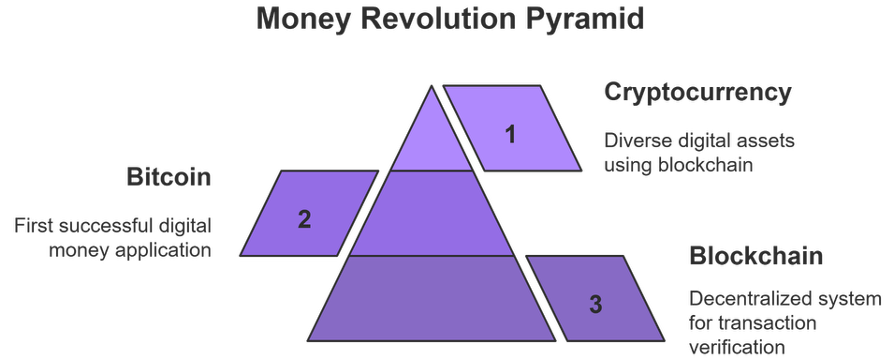
Understanding these distinctions matters because they represent different layers of the same innovation. Blockchain provides the foundation of trust without a central authority, Bitcoin proved this foundation could support real money, and the explosion of cryptocurrencies demonstrates how adaptable this technology truly is. Together, they’re reshaping how we think about money, ownership, and financial independence in the digital age.
Beyond Money: Industries Transformed
The impact of blockchain extends far beyond just digital money. Industries everywhere are discovering how this technology can solve old problems in new ways.
In healthcare, blockchain can keep medical records secure. It also allows doctors to access them quickly when needed. Patients control who sees their information, but emergency rooms can still access life-saving details when seconds matter.
In voting systems, blockchain could make elections more transparent and trustworthy. Every vote gets recorded permanently, making it nearly impossible to change results after the fact. People could verify their votes were counted correctly while still keeping their choices private.
Supply chains are becoming more transparent. Companies can prove their products are made ethically and sustainably. Consumers can scan a code to see exactly where their coffee beans were grown, when they were harvested, and their journey to the store.
Blockchain’s applications are rapidly moving beyond simple digital currency, profoundly disrupting traditional finance. Cross-border payments move money across countries in minutes instead of days, with much lower fees. Furthermore, smart contracts execute agreements automatically when conditions are met, reducing the need for lawyers and middlemen.
The innovation continues with decentralized lending, which allows people to lend money directly to each other without banks taking a cut. Programmable money creates digital dollars that can be programmed to only spend on certain things or at certain times. This collection of tools, along with 24/7 markets, provides financial markets that never close, unlike traditional stock exchanges.
The economic implications of programmable money are huge. Imagine money that automatically pays your bills, saves for retirement, or even negotiates better prices for you. This isn’t science fiction anymore. Early versions of these systems are working today.
This is why entrepreneurs and investors are paying such close attention to blockchain technology. It’s not just about making money by buying cryptocurrency. It’s about understanding how this technology will change business itself. Companies that figure out how to use blockchain effectively will have significant advantages over those that don’t.
Real-World Implementation Success Stories
Ford partnered with IBM to use blockchain technology for tracking cobalt in their electric vehicle batteries. Cobalt mining often involves child labor and unsafe working conditions. With blockchain, Ford can verify that their cobalt comes from ethical sources, allowing customers to trust that their electric car didn’t contribute to human rights violations. This gives Ford a competitive advantage and helps clean up an entire industry.
Major financial institutions are moving far beyond simple Bitcoin holdings, integrating cryptocurrency and blockchain technology across multiple operational layers. Traditional payment giants are embedding stablecoins directly into their transaction networks. Stablecoins are a type of cryptocurrency specifically designed to maintain a stable value, often pegged 1:1 to a real-world asset like the US dollar, to minimize the volatility typical of other cryptocurrencies. Visa has expanded its stablecoin settlement capabilities through partnerships, enabling payments using digital currencies on various blockchain networks.
This widespread integration demonstrates that institutions now view digital assets as a core part of future finance, rather than just a niche investment. Banks are building comprehensive digital asset custody platforms that integrate seamlessly with traditional securities. BNY Mellon has launched a digital asset custody platform enabling institutional clients to hold and transfer digital assets securely alongside traditional securities. This push establishes the necessary infrastructure for broader, regulated institutional participation in the digital asset economy.
River Financial’s 2025 analysis reported individuals held 65.9% of supply, while institutions (funds 7.8% + corporations 6.2% + governments 1.5%) collectively held 15–18% of Bitcoin’s circulating supply. This level of institutional adoption would have been unimaginable just a few years ago.
We’re still in the early stages of this revolution. The changes we’ve seen so far are just the beginning. As more people understand blockchain technology and more companies find ways to use it, the pace of change will only accelerate. Those who take time to learn these concepts now will be ready to take advantage of opportunities that others will miss.
The money revolution isn’t coming in the future; it’s happening right now. By the end of this post, you’ll understand exactly how to be part of it safely and confidently.
Part Two
HOW BLOCKCHAIN REALLY WORKS
Think of blockchain like a classroom where every student has the exact same notebook. Any time someone writes something new, everyone else copies it down immediately, making it virtually impossible to cheat since everyone would spot any fake entry right away.
This is exactly how blockchain works. It’s a system where thousands of computers around the world keep the same records. When someone tries to change something dishonestly, all the other computers catch it instantly.
Understanding blockchain might seem hard, but it’s built on simple ideas that work together. Once you grasp these basics, the whole world of cryptocurrency will make sense.
The Three Pillars of Blockchain Technology
Every blockchain rests on three main ideas. Think of them as the foundation of a house. Without all three, the system falls apart.
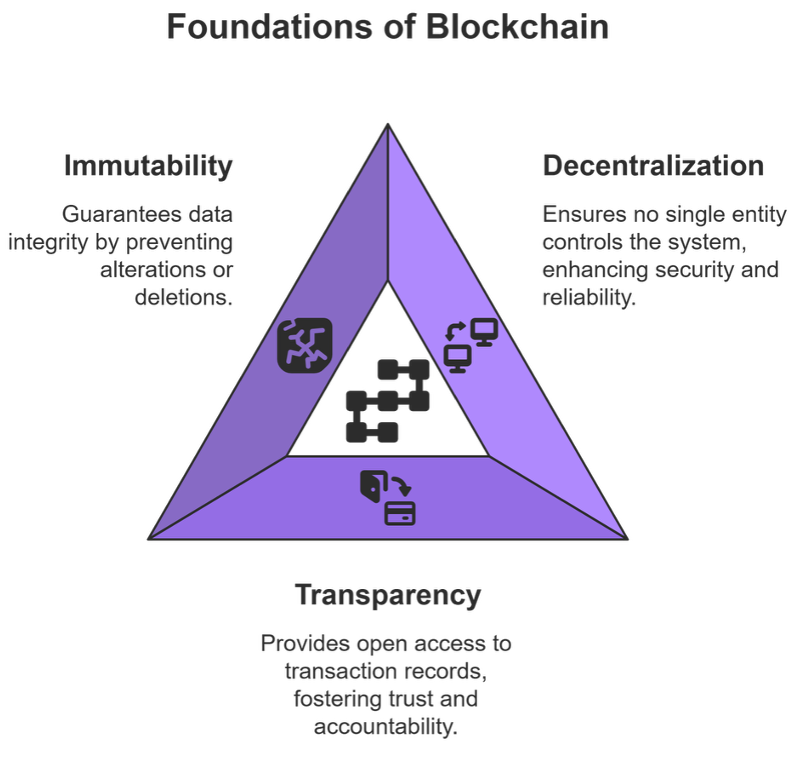
Decentralization means no single person or company controls the system. Instead of one bank keeping track of your money, thousands of computers do it together. When one computer breaks or tries to cheat, the distributed nature of the system ensures that all other computers continue working perfectly, maintaining the network’s integrity without any single point of failure.
Transparency means everyone can see what happens. Every transaction gets recorded where anyone can check it. While you might not know who sent the money, you can see that it moved from one account to another. This visibility creates accountability without compromising privacy completely.
Immutability means once something gets written down, it cannot be erased or changed, which creates a permanent history that no one can fake. This permanence ensures that all historical data remains trustworthy and verifiable forever.
Traditional banks work like this: you give them your money, and they write down that you have it in their private ledger. Only the bank can change those numbers. When the bank makes a mistake or gets hacked, this centralized approach creates vulnerability that could result in significant losses for customers.
Blockchain flips this completely. Instead of one bank, thousands of computers called nodes keep track of everyone’s money. These nodes are spread across the world, owned by different people and companies.
When you want to send money, you don’t ask permission from a bank but instead announce it to the network, where thousands of computers check if you really have the money to send. If most of them agree you do, the transaction goes through. This system is incredibly secure because you would need to hack thousands of computers at exactly the same time to fake a transaction, which is nearly impossible.
Nodes are computers that store and verify blockchain data. Miners are special nodes that create new blocks and earn cryptocurrency rewards. Validators are nodes that check transactions and vote on which ones are real. Collectively, these components and principles create a system built on trust through computation, not trust through an institution.
From Click to Confirmation
Let’s follow what happens when you send Bitcoin to a friend. This journey shows how blockchain turns a simple click into an unbreakable record.
The first step begins when you decide to send money. You open your wallet app and enter your friend’s address, like typing their email, along with how much to send and the fee you want to pay.
Next, when you hit send, your wallet creates a digital message stating your intent to transfer funds and signs it with your private key as proof of ownership. This cryptographic signature is unique and cannot be forged.
At this point, your transaction gets broadcast to the network. Thousands of computers receive your transaction and start checking it. They make sure you actually have the Bitcoin you want to send and that you haven’t already spent it somewhere else.
Then, miners collect your transaction along with hundreds of others. They bundle these transactions into a block and compete to solve a complex math puzzle. The first miner to solve it gets to add their block to the blockchain.
Finally, the process completes when the new block gets added to the chain. Your transaction is now permanent and can’t be reversed. Your friend’s wallet shows the new Bitcoin, and the network moves on to process the next batch of transactions. The whole process usually takes between 10 minutes to an hour for Bitcoin, depending on how busy the network is and how much fee you paid.
The most impressive part of blockchain is how thousands of computers agree on what’s true without anyone being in charge. This agreement process is called consensus. It’s the critical mechanism that ensures all participants have the same, verified record of transactions. Proof of work (PoW) is Bitcoin’s method for achieving this consensus.
PoW is a resource-intensive way to secure the network. Under this system, miners compete to solve difficult math puzzles using powerful computers. While these puzzles require significant electricity to solve, they remain easy for other computers to verify. The winner gets to add the next block and earns new Bitcoin as a reward.
This system works because cheating would require controlling more than half of all the computing power on the network. Bitcoin miners collectively use as much electricity as entire countries. Taking over this network would cost billions of dollars, making such an attack economically unfeasible.
Proof of stake is a newer method used by Ethereum and other blockchains. Instead of solving puzzles, validators put up their own cryptocurrency as collateral. If validators verify transactions honestly, they earn rewards, but if they attempt to cheat, they forfeit their stake.
This approach uses much less energy while staying secure. Cheating would require owning more than half of all staked cryptocurrency, which would be extremely expensive and would crash the price of your own holdings.
Smart Contracts and Blockchain Applications
Traditional contracts need lawyers and courts to enforce them. Smart contracts enforce themselves automatically using code. Imagine you want to sell your car. Normally, you would meet the buyer, exchange money for keys, and sign paperwork. With a smart contract, you could write code that says, “When this contract receives $10,000, automatically transfer ownership of the car.”
The blockchain would hold the money and the digital car title. When the buyer sends payment, the smart contract instantly gives them the car and gives you the money. This process eliminates the need for lawyers, paperwork, or waiting periods.
Smart contracts work for much more than simple trades. They can create entire applications that run automatically. Decentralized exchanges let people trade cryptocurrencies without any company running the exchange. Insurance contracts can pay out claims instantly when certain conditions are met.
While Bitcoin showed the world that digital money was possible, Ethereum created the first blockchain designed for smart contracts. While Bitcoin can only process simple transactions, Ethereum functions like a full computer capable of running any program you write. This flexibility made Ethereum the foundation for thousands of applications.
Using Ethereum costs “gas fees” paid in ETH, Ethereum’s cryptocurrency. These fees pay validators to run your smart contract code. Complex programs require more gas fees, similar to how longer car trips consume more gasoline. The Ethereum ecosystem now includes everything from games to insurance to lending platforms. All of these applications share the same underlying blockchain, making them secure and connected.
Understanding Blockchain’s True Potential
Blockchain technology powers more than just Bitcoin. It’s a new way to create systems where strangers can work together without trusting each other. The key insight is that math and code can replace many roles that humans used to fill. Instead of trusting a bank to hold your money, you trust the math that secures blockchain. Instead of trusting a company to run a fair exchange, you trust the code of a smart contract.
This doesn’t mean blockchain replaces everything. However, blockchain excels in specific areas, particularly those involving money or valuable records. For these applications, it offers unmatched security and transparency compared to traditional systems. The technology relies not on magic but on clever mathematics functioning precisely as intended.
Now that you understand how blockchain really works, you’re ready to learn how to safely buy, store, and manage your own cryptocurrency. The foundation you’ve built here will make everything else much clearer as we move forward.
Part Three
YOUR FIRST STEPS INTO CRYPTO OWNERSHIP
You’ve read about Bitcoin for years and understand it’s important. But every time you consider buying some, you get overwhelmed by wallets, keys, exchanges, and fees.
You’re not alone. Most people feel this way when they first consider owning cryptocurrency. The good news is that buying and owning digital money is much simpler than it seems once you understand the basics.
The world of cryptocurrency can feel like a maze of confusing terms and complicated processes. But just like learning to use online banking, once you take that first step, everything becomes clearer. Buying cryptocurrency is safer and easier than ever before. You just need to know where to start.
Understanding the Cryptocurrency Terrain
Not all cryptocurrencies are the same. Each one serves a different purpose and works in its own way. See them as different tools in a toolbox. You wouldn’t use a hammer to tighten a screw, and you wouldn’t use every cryptocurrency for the same purpose.
Bitcoin was the first cryptocurrency. It remains the most well-known. Many people call it “digital gold” because it stores value over time. Bitcoin has a limited supply, which means only 21 million Bitcoin will ever exist. This scarcity helps explain why many investors see it as a way to protect their money from inflation.
Ethereum works differently from Bitcoin. While Bitcoin focuses on being digital money, Ethereum acts like a computer that runs programs called smart contracts. These contracts can automatically execute agreements without needing a middleman. This makes Ethereum valuable for applications beyond just sending money.
Stablecoins offer something unique in the crypto world: stability. Most cryptocurrencies go up and down in price every day. But stablecoins are designed to stay at the same value, usually one dollar. They combine the benefits of cryptocurrency technology with the predictable value of traditional money.
Thousands of other cryptocurrencies exist, often called “altcoins.” Each promises something different. Some focus on faster transactions, others on privacy, and some on specific industries like gaming or healthcare. As a beginner, it’s best to start with the well-established cryptocurrencies before exploring these alternatives.
Market capitalization shows the total value of a cryptocurrency’s supply. Cryptocurrencies with larger market caps tend to be more stable and widely accepted. Liquidity refers to how easily you can buy or sell a cryptocurrency. Higher liquidity means you can trade quickly without affecting the price much.
Wallets Demystified: Your Digital Fort Knox
A cryptocurrency wallet doesn’t actually store your coins the way a physical wallet stores cash. Instead, it stores the keys that prove you own cryptocurrency on the blockchain. Understanding this difference is crucial for keeping your money safe.
Your wallet contains two types of keys that work together. Your public key is like your bank account number. You can share it with others so they can send you money. Your private key functions like your password and PIN combined. Anyone who has your private key can spend your cryptocurrency, so you must keep it secret at all times.
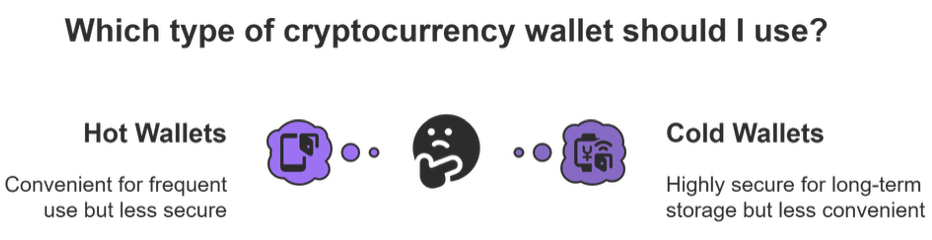
Hot wallets connect to the internet and make it easy to buy, sell, and use your cryptocurrency every day. These include apps on your phone or software on your computer. They’re convenient but slightly less secure because they’re online, where hackers might reach them.
Cold wallets store your keys completely offline. Hardware wallets are special devices that look like USB drives and provide excellent security. They’re perfect for storing larger amounts of cryptocurrency that you don’t need to access often. Paper wallets involve writing your keys on paper, but most experts now recommend hardware wallets instead.
When you first set up a wallet, it will give you a seed phrase. This phrase is usually 12 or 24 words that can restore your wallet if you lose your device. Write this phrase down on paper and store it somewhere safe. Never type it into a computer or take a photo of it.
This seed phrase is your backup plan and should be treated like the most valuable thing you own. Cryptocurrency security experts emphasize that storing recovery phrases digitally has become one of the costliest mistakes newcomers make, leading to millions in losses when devices get compromised or cloud accounts get hacked.
Making Your First Purchase
Buying cryptocurrency starts with choosing a reputable exchange. These platforms let you trade regular money for digital money. Several exchanges now stand out for their beginner-friendly security and ease of use.
Coinbase remains the most beginner-friendly option. Its interface is simple and clean, making it easy to understand what you’re doing. The platform follows strict regulations and stores most customer funds offline for security.
Gemini offers similar security with a strong focus on regulatory compliance and is highly regulated by the New York State Department of Financial Services. For those interested in learning while trading, eToro provides educational resources and social features. It helps beginners learn from experienced traders through its unique CopyTrader feature.
Before you can buy cryptocurrency, exchanges require you to verify your identity. This process is called KYC (know your customer) and involves uploading a photo of your driver’s license or passport, sometimes along with a selfie. This might seem annoying, but it protects both you and the exchange from fraud.
Funding your account is the next step. Most exchanges accept bank transfers, debit cards, and wire transfers. Bank transfers usually have the lowest fees but take longer. Credit card purchases are faster but cost more in fees. Your choice depends on whether you prioritize speed or saving money.
When you’re ready to make your first purchase, start small. Buy an amount you’re comfortable losing while you learn. Most exchanges let you buy fractional amounts, so you don’t need to buy a whole Bitcoin. You can start with as little as ten or twenty dollars.
After buying cryptocurrency on an exchange, you have a choice. You can leave it there for convenience, or transfer it to your personal wallet for maximum security. For small amounts, leaving it on a reputable exchange is usually fine. For larger amounts, transferring to a hardware wallet provides better security.
Understanding common beginner mistakes can save you significant money and stress. Not double-checking receiving addresses is perhaps the most expensive error newcomers make. Always copy and paste addresses rather than typing them manually, as even a single wrong character sends your money to the wrong place forever.
Ignoring network fees during busy periods can result in unexpectedly high transaction costs, particularly on networks like Ethereum. Another critical mistake involves sending cryptocurrency to the wrong network. Make sure the receiving wallet supports the same blockchain you’re using. Many people have lost money sending Bitcoin to Ethereum addresses or vice versa.
Storing seed phrases digitally rather than writing them on paper and storing them safely continues to lead to devastating losses when devices get hacked or accounts get compromised. Buying during hype peaks when prices are spiking often results in purchasing at inflated values. Instead, consider dollar-cost averaging over time.
Not enabling two-factor authentication on exchanges and wallet accounts leaves you vulnerable to unauthorized access. Finally, falling for “get rich quick” schemes and unrealistic promises often leads to scams. Stick to established cryptocurrencies and maintain realistic expectations about potential returns.
Sending and Receiving Like a Pro
Cryptocurrency transactions require careful attention to detail because they can’t be reversed if you make a mistake. This differs fundamentally from traditional bank transfers, where errors can often be corrected. Always double-check the receiving address before hitting send. Many wallets show you a QR code that makes this process easier and reduces the chance of errors.
Transaction fees vary based on how busy the network is. During busy times, fees can get expensive. Most wallets let you choose how much to pay in fees. Higher fees mean faster confirmation, while lower fees might take longer. For non-urgent transactions, choosing a lower fee can save you money.
Network congestion affects how quickly your transaction gets confirmed. Bitcoin transactions might take anywhere from ten minutes to several hours during busy periods. Ethereum can be even more unpredictable during peak usage times. Don’t panic if your transaction takes longer than expected. As long as you use the correct address, your money will arrive.
If something does go wrong, don’t assume your money is lost forever. First, check the transaction on a blockchain explorer using your transaction ID. This will show you the current status. If the transaction is confirmed but didn’t arrive at the destination, contact the receiving platform’s support team. Sometimes, technical issues cause delays that can be resolved.
Understanding these basics gives you the confidence to take your first steps into cryptocurrency ownership. The technology might seem complex, but the actual process of buying and managing digital assets is straightforward once you start.
Remember that every expert was once a beginner who took that first nervous step into this new world of digital money. According to recent data from Chainalysis, over $2.17 billion was lost in the first half of 2025 to various cryptocurrency scams and mistakes, but most of these losses could have been prevented with proper security practices and education.
Part Four
FORTIFY YOUR DIGITAL WEALTH
Cryptocurrency’s promise of financial freedom comes with a sobering reality: you become your own bank, complete with all the security responsibilities that entail. According to Reuters, in 2022, North Korean hackers stole $3.8 billion worth of cryptocurrency from unsuspecting investors and poorly secured platforms.
The good news is that protecting your digital wealth isn’t complicated. You just need to know what to look for and how to build proper defenses.
The Cybersecurity Challenge
The cryptocurrency world attracts both innovators and criminals in equal measure. Understanding the threats helps you spot danger before it’s too late. Scammers target beginners because they often lack experience with digital security, using emotional manipulation, fake urgency, and technical confusion to steal your money.
Common scam tactics have evolved into sophisticated operations that mirror legitimate businesses. Fake investment opportunities promise impossible returns through elaborate websites and professional-looking materials. Scammers create exact replicas of real cryptocurrency exchanges, complete with customer service and trading interfaces. They send emails pretending to be from trusted companies, asking you to click links and enter your wallet information to “verify” your account or claim rewards.
Artificial intelligence has supercharged these attacks. Deepfake technology now creates convincing videos of celebrities like Elon Musk promoting fake cryptocurrency giveaways, resulting in millions of dollars in losses. These AI-generated endorsements appear on legitimate platforms like YouTube, making them incredibly difficult to distinguish from real content.
Social engineering attacks target your emotions rather than your computer’s vulnerabilities. The infamous “pig butchering” scams demonstrate how patient criminals can be. A scammer contacts you through social media, builds a relationship over weeks or months through daily conversations and shared interests, then gradually introduces investment opportunities. They show fake trading screenshots, share stories of their own success, and create urgency around limited-time opportunities. These scams have stolen millions from victims who believed they were in genuine relationships.
Romance scams often serve as gateways to cryptocurrency fraud. The pattern typically begins on dating apps where scammers use attractive photos and compelling personal stories to build emotional connections. Once trust develops, they introduce cryptocurrency as a way to build a shared financial future. They might claim to have insider knowledge about upcoming price movements or exclusive access to high-yield investment platforms that aren’t available to the general public.
Warning signs that should immediately raise red flags include promises of guaranteed high returns with no risk, pressure to act quickly before missing a once-in-a-lifetime opportunity, requests to send cryptocurrency to unlock bigger rewards, poor grammar and spelling in supposedly professional communications, and unsolicited contact through social media or messaging apps asking about your investment interests.
Building Your Personal Security Fortress
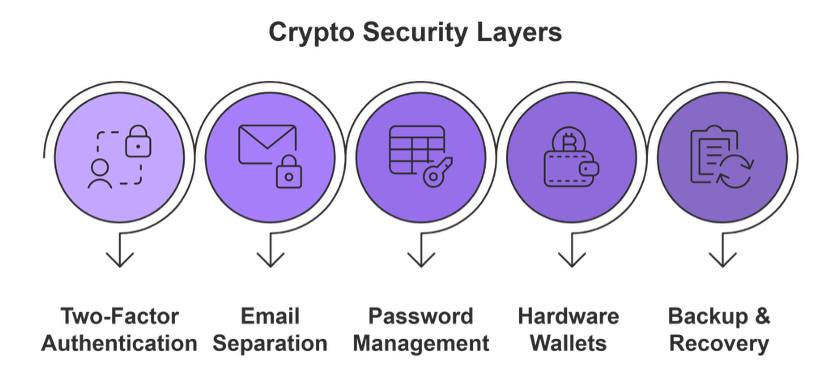
Two-factor authentication acts as your first line of defense against hackers by requiring both your password and a second form of identification, like a code from your phone, to access your accounts. Enable this security feature on every cryptocurrency exchange and wallet service you use, without exception. Even if hackers steal your password through a data breach or phishing attack, they still can’t access your accounts without that second authentication factor.
Email security forms the foundation of your crypto protection strategy. Create a separate email address just for your cryptocurrency accounts, as this reduces the risk of scammers finding and targeting your crypto-related communications. Use a strong, unique password for this dedicated email address and never use it for social media, shopping, or any non-crypto purposes. This compartmentalization means that even if your regular email gets compromised, your cryptocurrency accounts remain protected.
Password management requires a systematic approach that goes beyond simple complexity. Create long, unique passwords for each cryptocurrency account and never reuse them across different platforms. Password managers like Bitwarden or 1Password help you generate and store complex passwords without having to remember them all. These tools can create passwords with 20 or more random characters that would take centuries for computers to crack through brute force attacks.
Hardware wallets provide maximum security for serious cryptocurrency holdings by storing your private keys in physical devices that remain completely offline. These specialized computers, with popular brands including Ledger and Trezor, make it nearly impossible for hackers to reach your funds through internet-based attacks. While hardware wallets require an upfront investment of $50–200, they pay for themselves by protecting larger amounts of cryptocurrency from theft. Consider any cryptocurrency holding worth more than $1,000 as a candidate for hardware wallet storage.
Backup strategies ensure you never lose access to your funds, even if your devices break, get stolen, or become corrupted. Write down your seed phrase on paper and store it in a secure location like a safe deposit box, never storing seed phrases digitally or taking photos of them. Digital storage creates attack vectors for hackers, while physical paper remains immune to cyber threats.
Make multiple copies of your seed phrase and keep them in different physical locations. Test your backup system by recovering a small amount of cryptocurrency using only your written seed phrase to verify everything works correctly before you need it in an emergency.
Choosing Platforms and Managing Risks
Platform selection requires thorough research that goes beyond flashy marketing and attractive fee structures. Look for exchanges with several years of successful operation and good community reputations built through consistent performance during market stress.
Check whether the exchange is registered and regulated in your country, as regulated exchanges must follow specific security standards and consumer protection rules. They also typically carry insurance to protect customer funds in case of major security breaches.
Due diligence involves reading reviews from multiple independent sources while remaining skeptical of potentially fake testimonials. Professional review sites, cryptocurrency forums like Reddit’s r/CryptoCurrency, and industry publications often provide more reliable information than simple star ratings on app stores. Look for detailed feedback about customer service responsiveness, withdrawal processing times, and how platforms handle security incidents or technical problems.
Decentralized finance (DeFi) offers new ways to earn returns on cryptocurrency without traditional banking intermediaries, but creates additional risks that beginners must understand. Smart contracts power most DeFi applications, but they can contain bugs or vulnerabilities that hackers exploit for massive thefts.
Unlike traditional software, smart contracts can’t be easily updated once deployed, so if criminals find a weakness, they might drain funds from the entire platform before anyone can stop them. High returns in DeFi often come with correspondingly high risks through yield farming and liquidity mining that expose your funds to multiple potential failures, including platform hacks, token devaluation, or smart contract malfunctions. Therefore, navigating the DeFi space requires users to possess a high degree of technical understanding and a strong awareness of these inherent vulnerabilities.
Regulatory Reality: Taxes and Compliance
Cryptocurrency transactions create tax obligations in most countries, despite the technology’s pseudonymous nature. Government agencies worldwide are rapidly improving their ability to track cryptocurrency transactions and match them to individual taxpayers through sophisticated blockchain analysis tools and exchange cooperation agreements.
Starting in 2025, new reporting requirements require US-based exchanges to report customer transactions directly to tax authorities through the new Form 1099-DA system. This mandatory reporting means the government will automatically receive detailed records of your cryptocurrency trades, even if you don’t report them yourself. Similar regulations are being implemented across Europe, Canada, Australia, and other major markets.
Every cryptocurrency transaction potentially creates a taxable event that must be documented and reported. Buying, selling, trading, and spending cryptocurrency can all trigger tax obligations that vary significantly based on your country’s specific regulations. Even receiving cryptocurrency as payment for services, through airdrops, or as staking rewards might create immediate taxable income at current market values.
Record-keeping requirements make tracking all these transactions essential for legal compliance and financial planning. Save records of every purchase, sale, trade, and transfer, including dates, amounts, exchange rates, and the purpose of each transaction. Many cryptocurrency tax software tools like CoinTracker, Koinly, or TaxBit can help automate this tracking by connecting to your exchange accounts, but you still need to maintain accurate records throughout the year for transactions these tools might miss.
Working with tax professionals who understand cryptocurrency becomes increasingly important as your holdings grow and transactions become more complex. Tax rules for digital assets continue evolving rapidly, and mistakes can result in significant penalties, interest charges, and potential criminal liability for willful non-compliance.
Your Security Action Plan
Enable two-factor authentication on all cryptocurrency accounts.
Research platforms thoroughly before trusting them with funds.
Use hardware wallets for long-term cryptocurrency storage.
Keep detailed records of all transactions for tax purposes.
Never share private keys or seed phrases with anyone.
The security practices you develop now will protect your cryptocurrency investments as they grow in value and complexity. Start with basic protections like strong passwords and two-factor authentication, then gradually learn more advanced techniques like hardware wallet management and DeFi risk assessment.
Don’t forget that in cryptocurrency, you truly are your own bank, which means security becomes your personal responsibility rather than something you can delegate to others. Take that responsibility seriously, but don’t let fear prevent you from participating in this financial revolution that’s reshaping how we think about money and economic freedom.
Part Five
YOUR CONFIDENT FUTURE IN THE BLOCKCHAIN ERA
You’ve reached a pivotal point in your blockchain education. The confusion that once surrounded terms like “mining,” “private keys,” and “smart contracts” has transformed into a clear understanding. More importantly, you now possess the foundational knowledge to navigate an increasingly blockchain-integrated world with confidence and purpose.
From Confusion to Confidence
The transformation you’ve undergone while reading this post represents more than just learning new terminology. You’ve developed a fundamental understanding of how decentralized systems operate and why they matter. When you started, Bitcoin might have seemed like mysterious internet money. Now you understand the elegant solution it provides to the double-spending problem and why thousands of computers worldwide work together to maintain network security.
Your new grasp of blockchain fundamentals extends beyond cryptocurrency. You now understand how immutable ledgers create trust without intermediaries, why consensus mechanisms prevent fraud, and how cryptographic hashing ensures data integrity. These aren’t just technical concepts anymore. They’re tools for understanding a new paradigm of digital interaction that’s reshaping industries worldwide.
The practical skills you’ve acquired provide immediate value. You know the critical difference between hot and cold wallets, understand why your private keys must remain secret, and can identify common scams before they ensnare you. You’ve learned to verify transactions on blockchain explorers, understand gas fees, and recognize the importance of seed phrases. These skills become more valuable as blockchain technology integrates deeper into mainstream applications.
Perhaps most importantly, you’ve developed the ability to separate legitimate blockchain innovations from speculative hype. You can evaluate projects based on their technology, use cases, and teams rather than getting caught up in price movements or marketing promises. This discernment will serve you well as the blockchain space continues evolving and maturing.
Blockchain’s Expanding Horizons Beyond Digital Currency
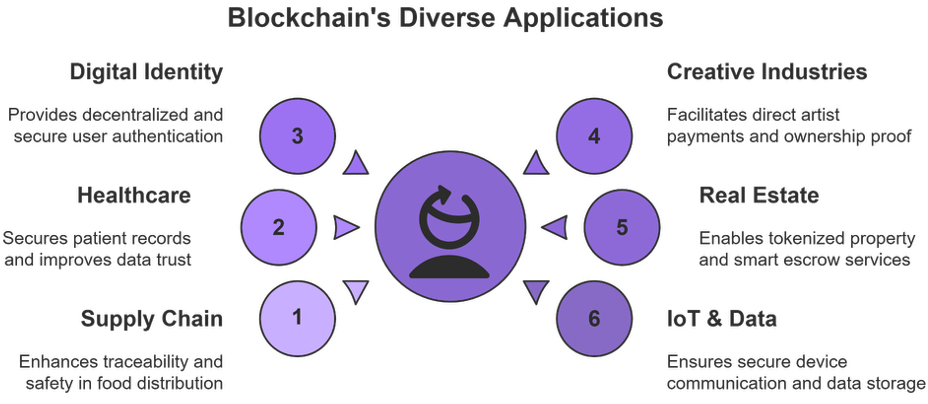
The same principles securing Bitcoin are now solving complex problems across numerous industries, creating opportunities that extend far beyond financial applications. Understanding these real-world implementations helps you recognize why blockchain literacy has become so valuable in today’s evolving technological domain.
Supply chain transparency has emerged as one of blockchain’s most impactful applications. IBM Food Trust, deployed by major retailers like Walmart and Nestlé, enables instant tracing of food products from farm to store shelf. When contamination occurs, companies can identify affected products in seconds rather than weeks, potentially saving lives and preventing widespread illness. This system has proven particularly valuable during food safety crises, where rapid response directly impacts public health outcomes.
Healthcare represents another sector experiencing blockchain transformation. Platforms like Medicalchain and Guardtime allow patients to own and control their electronic health records while securely sharing data with authorized providers globally. This patient-centric approach not only improves care coordination but also helps prevent counterfeit medications from entering supply chains. Clinical trials benefit from blockchain’s immutable record-keeping, ensuring research data remains tamper-proof and building trust in medical research outcomes.
Digital identity solutions are addressing one of the internet’s most persistent problems. Microsoft’s ION platform and the ID2020 initiative enable users to create decentralized identifiers that work across multiple services without relying on central authorities like Facebook or Google. Instead of managing dozens of usernames and passwords, users maintain one secure digital identity while controlling exactly what information they share with each service.
The creative industries are experiencing particularly dramatic changes through blockchain integration. Musicians on platforms like Audius receive direct payments from fans without record labels taking substantial cuts. Artists use blockchain to timestamp their work, creating immutable proof of creation and ownership. Smart contracts automatically distribute royalties to all contributors, eliminating the complex accounting systems that traditionally delayed payments for months or years.
Real estate transactions, historically bogged down by paperwork and intermediaries, are becoming more efficient through blockchain implementation. Platforms like Propy record property sales directly on blockchain networks, while smart contracts automate escrow processes that previously required multiple parties and lengthy verification periods. Fractional ownership becomes possible through tokenization, allowing smaller investors to own portions of high-value properties and democratizing access to real estate investment opportunities.
The Internet of Things gains enhanced security through blockchain integration. Your smart home devices, connected vehicles, and wearable technology will increasingly rely on blockchain networks to share information securely. Decentralized cloud storage solutions like Filecoin and Storj offer alternatives to traditional providers, giving users more control over their data while reducing risks associated with centralized storage systems.
Your Path Forward in the Blockchain Era
Knowledge without application remains purely theoretical. Your next steps involve translating understanding into practical experience through careful, measured engagement with blockchain technology. The goal isn’t to become an expert overnight but to build hands-on familiarity with systems you now understand conceptually.
Start your practical journey by setting up a basic wallet using one of the reputable options discussed earlier. Begin with a small amount you can afford to lose completely. This isn’t about making money but about understanding how transactions actually work, how network fees function in practice, and what it feels like to manage your own private keys. The experience of sending your first transaction provides insights that no amount of reading can replace.
Community engagement accelerates your learning while providing valuable networking opportunities. Reddit communities like r/CryptoCurrency offer beginner-friendly environments where you can ask questions and learn from others’ experiences. Discord servers affiliated with reputable projects provide real-time discussions about technical developments and industry trends. Twitter remains a primary information source for blockchain professionals, though you’ll need to carefully curate your feed to focus on educational content rather than price speculation.
Building a long-term learning strategy requires identifying your specific interests and goals within the blockchain space. Entrepreneurs might focus on understanding how blockchain could streamline their existing business processes or create entirely new revenue models. Investors might concentrate on fundamental analysis techniques for evaluating blockchain projects, while technology professionals might pursue more technical education around smart contract development or blockchain architecture. Your strategy should align with your broader professional and personal objectives rather than following generic advice.
Staying current requires commitment to continuous education through multiple channels. Industry publications like CoinDesk and Cointelegraph provide daily updates on technological developments, regulatory changes, and market movements. Educational platforms, including Binance Academy and Coinbase Learn, offer structured courses diving deeper into specific topics like decentralized finance, non-fungible tokens, and layer-2 scaling solutions.
For more structured learning, university-backed programs on Coursera and edX provide academically rigorous approaches to blockchain technology. The Token Metrics research indicates these platforms rank among the most effective educational resources for 2025, particularly Berkeley’s Blockchain Fundamentals course on edX and Princeton’s Bitcoin and Cryptocurrency Technologies program on Coursera. Subscription services like Upskillist offer practical, hands-on training covering emerging trends like AI integration with blockchain and real-world asset tokenization.
Books remain invaluable for developing a deep understanding of blockchain’s historical context and underlying principles. They provide comprehensive treatments of complex topics that shorter articles and videos often oversimplify. Podcasts and educational YouTube channels help you stay informed during commutes or exercise, though you should focus on creators who prioritize education over price predictions.
Embracing Your Role in the Digital Transformation
The blockchain revolution is not a distant future event but a current reality reshaping how value moves through society. Companies across industries are implementing blockchain solutions to increase transparency, reduce costs, and improve security. Governments are exploring central bank digital currencies that will bring blockchain technology directly into everyday financial transactions. Artists, musicians, and content creators are building direct relationships with audiences through blockchain-based platforms that eliminate traditional intermediaries.
Your education positions you advantageously as these changes accelerate. Employers increasingly value blockchain literacy as they explore how distributed ledger technology might benefit their operations. Investors who understand blockchain fundamentals can evaluate opportunities more effectively than those relying solely on market sentiment. Entrepreneurs with blockchain knowledge can identify problems that distributed systems might solve more efficiently than traditional approaches.
The technology continues evolving rapidly, with new applications emerging regularly. Web3 protocols are creating an internet infrastructure where users own their data rather than surrendering it to centralized platforms. Supply chains are becoming more transparent as blockchain tracking becomes standard practice. Healthcare systems are improving patient outcomes through better data sharing enabled by blockchain security.
Most importantly, you’re no longer dependent on others to explain blockchain developments. You can read industry news with comprehension, evaluate new projects with informed skepticism, and make decisions based on understanding rather than speculation. This independence becomes more valuable as blockchain technology becomes more prevalent and the stakes of understanding or misunderstanding it increase.
Your blockchain education represents an investment in technological literacy that will pay dividends for years to come. The principles you’ve learned apply to emerging technologies beyond current blockchain applications. The analytical skills you’ve developed help you evaluate other technological claims and promises with appropriate skepticism. The confidence you’ve gained from mastering complex concepts prepares you for future technological changes that will inevitably reshape our world.
The blockchain era is unfolding around us, and you now possess the knowledge and tools to participate confidently rather than merely observe. Your next chapter begins with taking that first practical step forward.